
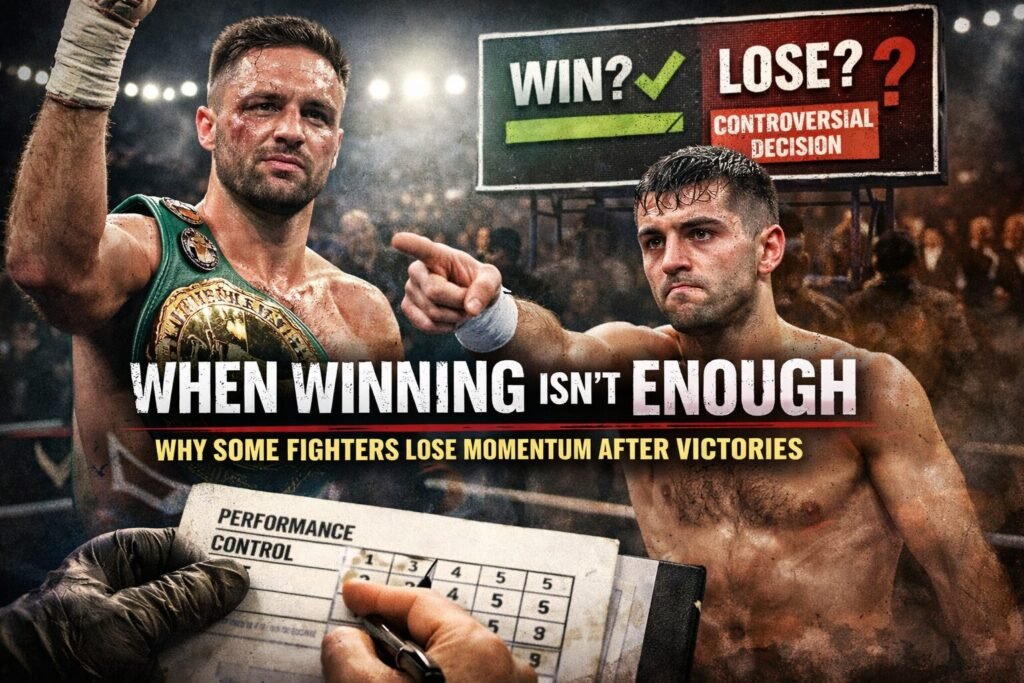
Boxing has always told us one thing: win and you move on. Your record improves, your ranking climbs, the next opportunity opens up.
Except modern boxing doesn’t really work like that anymore.
These days, fighters can win on the scorecards and still walk away worse off than they were before. No buzz. No clarity. No obvious next step. Just questions. That’s how we end up with a growing list of fighters winning fights but losing momentum — and it’s one of the quietest problems in the sport.
Because somewhere along the line, boxing developed a second scorecard.
The Result Isn’t the Whole Story Anymore
Officially, boxing still runs on rounds, points, and decisions. Unofficially, fans, media, broadcasters, and promoters are judging something else entirely.
They’re asking:
- Who actually controlled the fight?
- Who looked comfortable at the level?
- Who adapted when things went wrong?
- Who looked like they belonged there?
This is why unconvincing boxing wins often do more harm than good. A narrow points decision over the “wrong” opponent can cool hype instantly, while a dominant loss can sometimes raise a fighter’s stock.
That eye-test culture didn’t exist to this degree 20 years ago. Now it drives everything — from matchmaking to promotion to how a fighter is spoken about on Monday morning.
The Result Isn’t the Whole Story Anymore
Officially, boxing still runs on rounds, points, and decisions. Unofficially, fans, media, broadcasters, and promoters are judging something else entirely.
They’re asking:
- Who actually controlled the fight?
- Who looked comfortable at the level?
- Who adapted when things went wrong?
- Who looked like they belonged there?
This is why unconvincing boxing wins often do more harm than good. A narrow points decision over the “wrong” opponent can cool hype instantly, while a dominant loss can sometimes raise a fighter’s stock.
That eye-test culture didn’t exist to this degree 20 years ago. Now it drives everything — from matchmaking to promotion to how a fighter is spoken about on Monday morning.
Case Study: Josh Taylor vs Jack Catterall — The Win That Cost Everything
If you want the clearest modern example of winning fights but losing momentum, it’s impossible to look past Josh Taylorvs Jack Catterall.
On paper, Taylor did exactly what a champion is supposed to do.
He won.
He retained his undisputed titles.
His undefeated record stayed intact.
In reality, that night changed how he was viewed forever.
From the opening rounds, Catterall controlled the tempo, disrupted Taylor’s rhythm, and forced him into survival mode. Taylor looked frustrated, reactive, and short of ideas. When Catterall dropped him, the mood in the arena shifted — and it never really shifted back.
By the time the decision was read, the reaction told its own story. The belts stayed with Taylor, but almost nobody believed the narrative anymore.
That’s boxing’s second scorecard in action:
- Control: Catterall
- Composure: Catterall
- Clarity: Catterall
Taylor “won”, yet the fallout was brutal. Endless controversy. A delayed rematch. Belts vacated. And a permanent asterisk attached to a reign that should have been career-defining.
It’s the purest example of a win that actively stalled momentum.
Expectations Are the Hidden Opponent
Every fight comes with expectations attached. If a fighter is supposed to dominate and doesn’t, the conversation turns fast.
You hear it all the time:
- “He got the job done, but…”
- “That wasn’t convincing at this level.”
- “I expected more from him.”
Those “buts” matter. They turn wins into warnings.
This is why fighters on the rise are often judged more harshly than veterans. The higher the hype, the narrower the margin for error. A scrappy points win might keep a record clean, but it can quietly damage belief — especially when platforms like Sky Sports Boxing or Boxing News frame the performance rather than the result.
Style, Matchmaking, and the Context Trap
Not all wins are equal — and boxing does a terrible job of admitting that.
Low-output fighters, safety-first operators, or boxers reliant on physical advantages often find that winning fights but losing momentum becomes a pattern. Fans want answers. Matchmakers want clarity. Promoters want sellable progression.
And sometimes the opponent is the real problem.
Late replacements, faded names, or awkward stylistic match-ups can turn a victory into a shrug. The fighter did their job — but the win didn’t tell us anything new. That’s when careers stall, not because of losses, but because nothing moves forward.
It’s why The Ring often focuses on “what’s next” rather than celebrating the win itself. If a fight doesn’t create a clear next chapter, boxing simply drifts.
Boxing’s Unofficial Second Scorecard
Like it or not, boxing now runs on two systems at once.
One records the result.
The other judges dominance, adaptability, authority, and intent.
That second scorecard decides:
- Who gets pushed
- Who gets paused
- Who gets protected
- Who gets quietly exposed
And it’s why winning fights but losing momentum has become such a familiar pattern. Fighters aren’t just fighting opponents anymore — they’re fighting narratives, expectations, and long-term perception every time they step in the ring.
Winning Still Matters — But It’s Not Enough
This isn’t an argument for reckless knockouts or style over substance. But it is a reality check.
In modern boxing, a win needs to mean something. It needs to answer a question. If it doesn’t, the sport moves on quickly — sometimes brutally so.
That’s not fair. But it is where boxing is right now.
Over to You
Which fighters have you seen win fights but lose momentum? Are fans judging performances more harshly than ever — or is this just boxing catching up with itself?
Drop your thoughts in the comments, share this piece with other boxing obsessives, and head over to CMBoxing for more opinion-led writing that looks beyond the scorecards and into what actually moves careers forward.