
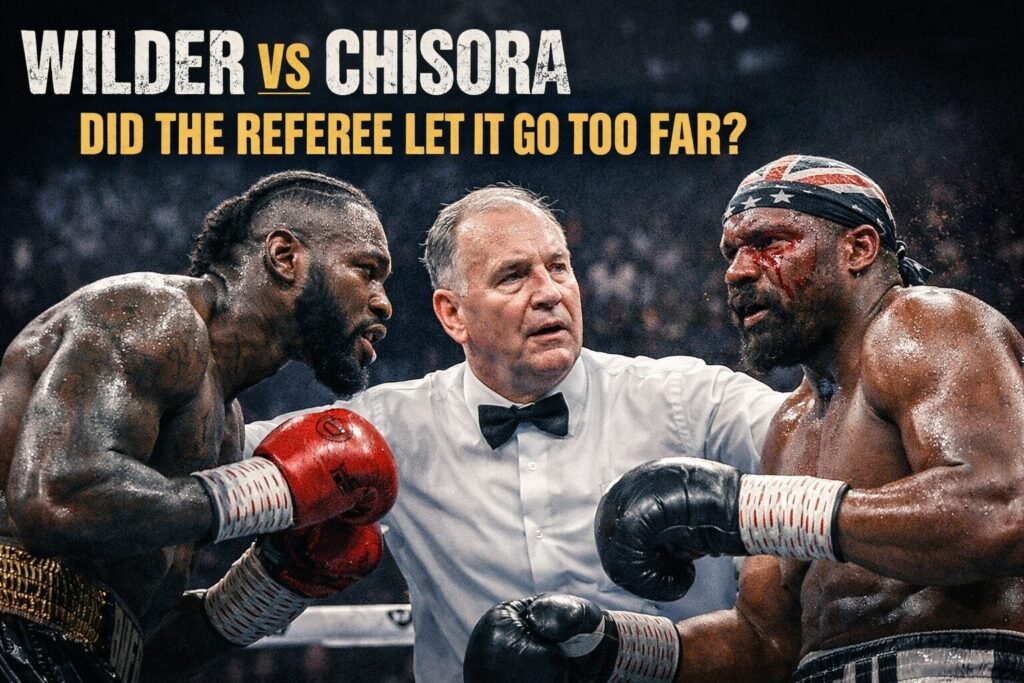
The Result Isn’t the Real Story
On paper, Deontay Wilder vs Derek Chisora ends as a split decision win for Wilder.
But let’s be honest — the result isn’t what people are talking about.
The real conversation is around the Wilder Chisora referee stoppage, or more specifically, the lack of one.
Because while Chisora did what Chisora always does — walk forward, take shots, refuse to quit — there were clear moments where the fight felt like it had crossed from competitive into unnecessary punishment.
And that’s where the responsibility shifts.
Not to the judges. Not to the fighters.
To the referee.
Toughness vs Safety — Where Is the Line?
We’ve always celebrated toughness in heavyweight boxing. Fighters like Chisora have built entire careers on it.
But toughness can’t be the only metric.
There were periods in this fight where Chisora’s defence wasn’t just loose — it looked non-existent. Shots were landing clean, repeatedly, and without meaningful resistance.
That’s the exact moment referees are trained to recognise.
If you’ve ever read how officiating is supposed to work, the role isn’t just to enforce rules — it’s to protect fighters when they can no longer protect themselves.
And that’s the key question here:
Was Chisora still intelligently defending himself — or just surviving?
Because those are two very different things.
The Corner Has Questions to Answer Too
It’s easy to focus entirely on the referee, but the corner cannot escape criticism here either.
There’s a reason the towel exists.
When a fighter won’t quit — and fighters like Chisora never do — the responsibility often falls to the people who know them best.
We’ve seen it before in boxing: brave fighters left in too long because no one wants to be the one to stop it.
But that’s exactly the job.
And in this case, you could argue both the referee and the corner hesitated when the situation demanded decisiveness.
This Isn’t Happening in Isolation
What makes this even more uncomfortable is the timing.
This week alone, the sport has already been forced to confront another situation where a fighter ended up in hospital following a bout, with both the referee and the corner facing scrutiny.
That context matters.
Because when incidents like this stack up, it stops being about one fight — and starts becoming a wider conversation about standards across the sport.
The concern isn’t just what happened in Wilder vs Chisora.
It’s what it represents.
The Problem With Letting Heavyweights “Figure It Out”
There’s always been a tendency in heavyweight boxing to give fighters “every chance.”
Big names. Big punches. Big expectations.
But that mentality can be dangerous.
Heavyweights don’t need sustained punishment to change a fight — one shot is enough.
So when a fighter is already taking repeated clean hits, letting it continue doesn’t increase competitiveness… it increases risk.
That’s where the Wilder Chisora referee stoppage debate really sits.
Not in hindsight.
In responsibility.
Full Transparency — And Why It Still Matters
I’ll be honest — I wasn’t a fan of this fight from the start.
I didn’t watch it live. I followed the reaction, read the reports, and then watched the highlights after.
And sometimes, that actually gives you a clearer view.
Because when the consistent takeaway across multiple observers is the same — that it went on too long — it usually means there’s something in it.
So… Did the Referee Get It Wrong?
This is where it gets tricky.
Referees have to make decisions in real time. No replays. No slow motion. No second chances.
And in heavyweight boxing, the margin for error is razor thin.
But that doesn’t mean they’re beyond criticism.
In this case, it’s fair to ask:
- Did Chisora show enough to justify continuing?
- Or was he relying purely on toughness?
- And if it’s the latter — should the fight have been stopped?
Because if we’re honest, this didn’t feel like a fight that suddenly turned dangerous.
It felt like one that was allowed to stay dangerous for too long.
Final Thoughts
The Wilder Chisora referee stoppage debate isn’t about blaming one individual.
It’s about recognising a pattern that boxing still struggles with:
Knowing when enough is enough.
Chisora’s bravery is unquestionable.
Wilder got the win.
But the lasting image isn’t the scorecards.
It’s the uncomfortable feeling that maybe — just maybe — the fight should have been stopped earlier.
What Do You Think?
Did the referee get it right — or was this allowed to go too far?
Drop your thoughts in the comments, share this with other fight fans, and head over to CMBoxing for more honest, no-nonsense boxing analysis.