
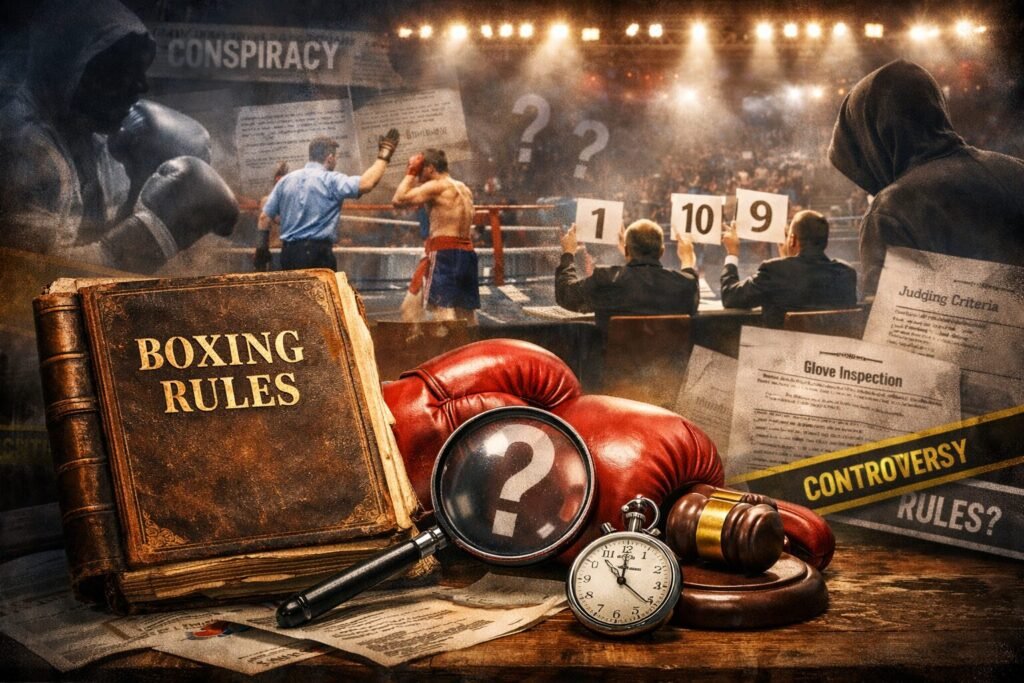
If there’s one phrase that trends every time there’s a controversy, it’s this: “That’s not even in the rules.”
Glove rows. Scorecard outrage. Referees breaking fighters too quickly on the inside. Cornermen accused of bending the rules. Social media explodes — and nine times out of ten, the loudest opinions come from people who’ve never actually read a rulebook.
That’s not a dig at fans. It’s a failure of the sport.
Because when it comes to boxing rules explained, boxing does a terrible job of explaining them.
And that vacuum? It gets filled with conspiracy theories.
The Rules Exist – But Nobody Sees Them
Modern boxing is governed by layers of regulation — local commissions, sanctioning bodies, and the foundations laid by the Marquess of Queensberry Rules.
If you want historical context, I’ve already broken down where the sport began in The History of the Queensberry Rules.
But here’s the issue: most fans don’t see the modern versions of those rules.
Each fight operates under:
- A local commission’s regulations
- A sanctioning body’s championship rules (WBC, WBA, IBF, WBO etc.)
- Agreed fight-night protocols
Yet how often do broadcasters actually explain them clearly before a fight?
Almost never.
Compare that to other sports. In football, VAR is debated endlessly — but at least the rule framework is public and discussed. In rugby, referees explain decisions live through the mic. In boxing, we get silence.
And silence breeds suspicion.
Glove-Gate and the Cost of Ignorance
When glove controversies surface, the same arguments repeat:
- “The gloves were tampered with.”
- “The ref should have stopped that.”
- “That’s illegal.”
Sometimes those accusations collapse under basic scrutiny. Sometimes they expose grey areas. But almost always, they spiral because fans don’t know what the rules actually say.
Under commission oversight, gloves are:
- Approved models
- Inspected pre-fight
- Observed by opposing teams
- Signed off by officials
That doesn’t mean mistakes never happen. But it does mean the process is far stricter than social media suggests.
If more people understood how the regulatory chain works, we’d have fewer viral conspiracy threads.
And that ties directly into what I explored in Boxing Accountability: Is the Sport Too Comfortable Letting Questions Go Unanswered?.
Because the issue isn’t just ignorance — it’s communication.
When Fighters Stop Trusting the System
Here’s where it gets more serious.
It’s one thing when fans misunderstand the rules.
It’s another when fighters do.
We’ve seen growing frustration in recent years — public complaints about referees, judging standards, even equipment oversight. When fighters openly question governance, it chips away at credibility.
I covered this deeper in When Fighters Stop Trusting Boxing.
If boxers themselves feel unclear or unsupported, that’s a systemic problem.
Because without trust in:
- How fouls are enforced
- How rounds are scored
- How point deductions are applied
You don’t just lose clarity.
You lose legitimacy.
Judging: The Most Misunderstood Area of All
If we’re being honest, boxing rules explained rarely includes a proper breakdown of scoring.
The 10-point must system isn’t complicated — but it is subjective.
Judges score:
- Clean punching
- Effective aggression
- Ring generalship
- Defence
Not crowd noise. Not commentary bias. Not social media reaction.
Websites like the British Boxing Board of Control publish regulations. The Association of Boxing Commissions provides unified rules documentation. But how many fans are directed to those resources during a broadcast?
Very few.
And that’s where misinformation thrives.
The Referee Problem Isn’t Always a Problem
Referees get hammered after controversial stoppages or inside fighting breaks.
But most fans don’t understand:
- Clinch thresholds
- Head clash rulings
- When a point deduction is discretionary
- When a doctor’s stoppage overrides everything
Those decisions aren’t random.
They’re written into commission policy.
The problem? They’re not explained clearly enough in real time.
So every judgement call feels personal.
Why Commissions Need to Do Better
Let’s be blunt.
Boxing cannot afford to keep assuming fans will “figure it out”.
If you want fewer conspiracy theories:
- Publish simplified fight-night rule summaries
- Make scoring criteria part of broadcast graphics
- Have referees mic’d during key explanations
- Provide transparent post-fight officiating reports
Transparency doesn’t weaken authority.
It strengthens it.
Right now, too much of boxing governance feels hidden — even when it isn’t.
And when rules aren’t visible, they’re questioned.
Boxing Rules Explained: The Sport’s Biggest PR Gap
The irony?
Boxing has rules. Detailed ones. Layered ones. Historic ones.
But it rarely explains them.
And until boxing rules explained becomes part of mainstream fight coverage, every close decision, every glove swap, every referee intervention will feel suspicious to someone.
The sport doesn’t just need better officiating.
It needs better education.
Final Bell
So here’s the question:
Is boxing suffering from corruption — or from poor communication?
Maybe sometimes both.
But one thing is certain: the more transparent the rulebook becomes, the fewer myths survive.
If you care about clarity in this sport, share your thoughts below. Have you ever changed your opinion on a controversy after learning the actual rules?
And if you want more straight-talking breakdowns like this, head over to CMBoxing and explore the full archive.
Because boxing deserves debate.
But it also deserves understanding.