
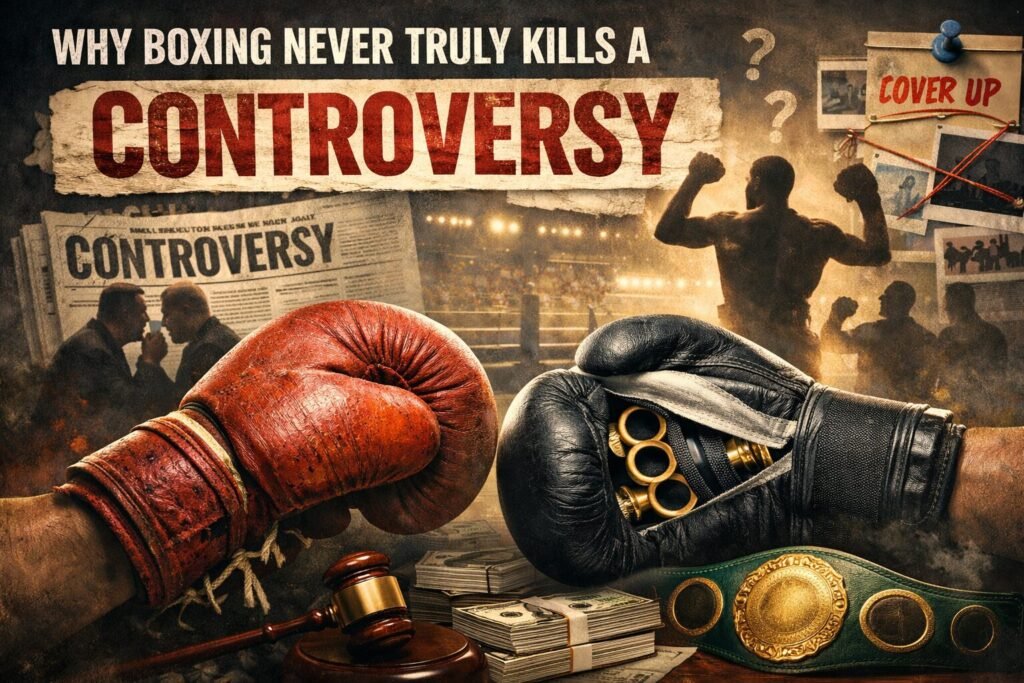
Let’s be clear: controversy can be brilliant for boxing.
A perfect example is Froch vs Groves I. The first fight ended in chaos, with referee Howard Foster stepping in after Carl Froch caught George Groves with a huge right hand that left him wobbling on unsteady legs. Some felt it was a sensible stoppage. Others swear blind it was early. That argument will never be settled — and that’s fine.
Without that disputed ending, we don’t get Froch vs Groves II at Wembley, one of the biggest nights in British boxing history. Over 80,000 fans, genuine needle, and a rematch that actually delivered closure inside the ring.
That’s controversy working as it should.
The issue is what happens after that — when promoters, fighters, and sometimes even fans refuse to move on because keeping the argument alive is more profitable than resolving it.
When Boxing Chooses Ambiguity Over Answers
Modern boxing has a strange relationship with truth.
Allegations are made. Accusations go viral. Counter-claims follow. But rarely do we see decisive, transparent investigations that actually end the discussion. Instead, we get half-statements, vague reassurances, and just enough noise to keep both sides shouting.
Look at how often governing bodies issue carefully worded responses that say plenty without really saying anything at all. No clear findings. No hard evidence released. Just enough denial to proceed with business as usual.
From an SEO point of view, this is boxing controversies explained in one sentence:
boxing doesn’t lack answers — it avoids them.
Wilder–Fury and the Art of Never Letting Go
The Wilder–Fury rivalry should have ended cleanly.
Three fights. One clear winner in the ring. A definitive conclusion for most observers. And yet, years on, glove tampering accusations, costume excuses, loaded gloves, spiked water claims, and phantom injuries are still being recycled online.
Why?
Because controversy keeps a fighter relevant when results no longer do.
And because boxing, unlike many sports, rarely steps in to draw a firm line under these narratives. There’s no authoritative body saying “this has been investigated, here is the evidence, discussion closed”.
Instead, the silence allows conspiracy to flourish — and for some, that’s preferable.
Governing Bodies: Passive by Design?
One of the reasons boxing struggles to kill a controversy is structural.
The sport is fragmented. Multiple sanctioning bodies. Different commissions. Overlapping jurisdictions. Responsibility is easily passed around like a hot potato. When something awkward happens, nobody seems quite sure whose job it is to deal with it decisively.
Contrast that with other sports, where central authorities publish reports, impose sanctions, and — crucially — explain their decisions in detail.
Boxing rarely does that. And when it does, it often arrives too late, long after public opinion has hardened.
This lack of transparency doesn’t just damage trust — it actively encourages suspicion.
Why Promoters Don’t Really Want Closure
Here’s the uncomfortable truth.
Promoters don’t need certainty. They need conversation.
An unresolved controversy keeps fighters in headlines. It gives pundits something to argue about. It creates narratives without requiring new fights. From a marketing point of view, it’s cheap, effective, and endlessly reusable.
That’s why some disputes are never fully addressed — because ambiguity is easier to sell than truth.
This is why boxing controversies explained isn’t about corruption in every case. Often it’s about indifference. About letting noise exist because silence might cost money.
The Cost to the Sport
The long-term problem is credibility.
When boxing never definitively resolves disputes, fans stop trusting outcomes. Every loss becomes an excuse. Every win becomes suspicious. The sport slowly trains its audience to doubt what they’re watching.
Controversy should enhance rivalries — not undermine the results themselves.
Boxing doesn’t need to be sanitised. It needs to be braver about closure.
Boxing Doesn’t Need Less Controversy — It Needs More Backbone
Controversy will always exist in boxing. And that’s fine. It’s part of the sport’s DNA.
But there’s a difference between genuine debate and endless recycling. Between rivalry and refusal to accept reality. Between healthy disagreement and structural avoidance of accountability.
Until boxing learns to properly investigate, clearly communicate, and decisively close chapters, controversies will never die — because too many people benefit from keeping them alive.
And that, more than any glove theory or injury claim, is the real problem.
Over to You
Do you think boxing benefits from never fully resolving controversies — or is it slowly damaging the sport’s credibility?
Drop your thoughts in the comments, share this piece with other boxing fans, and head over to CMBoxing for more opinion-led boxing analysis that actually asks uncomfortable questions rather than recycling easy narratives.