
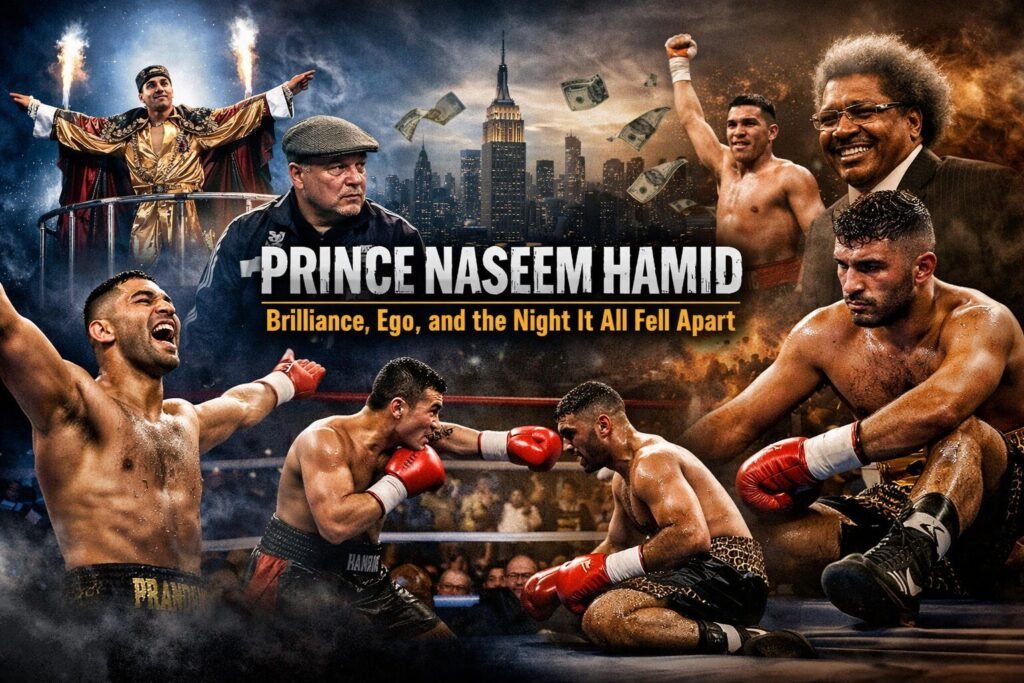
With the Prince Naseem Hamid film landing, boxing fans are doing what boxing fans always do — arguing, romanticising, and selectively remembering. Highlights are flying around again. The entrances. The knockouts. The swagger. The chaos.
But if we’re going to talk honestly about the Prince Naseem Hamid career, we can’t just live in the highlight reel. Because Naz was one of the most gifted fighters this country has ever produced — and also one of the most frustrating.
This isn’t about disrespect. I’ve got respect for anyone who gets in the ring. Always have. But I was never a Naz fan in the way others were. Same with Muhammad Ali, same more recently with Ben Whittaker. Showboating fighters never did it for me. If anything, I always wanted to see them tested — really tested — because that’s where boxing tells the truth.
And when Naz finally was tested, everything fell apart.
A Once-In-A-Generation Talent — No Debate
Let’s get this out of the way early: the Prince Naseem Hamid career doesn’t need exaggeration. The talent was obscene.
Fast hands. Unreal reflexes. Power that made no sense for his size. He could knock you out from angles that shouldn’t exist, with his feet pointing the wrong way and his hands dangling at his waist.
He didn’t just beat opponents — he embarrassed them.
And crucially, he wasn’t just a British star. Naz crossed over. He sold fights. He made Americans watch British boxing. He became an event, not just a champion.
For a time, he looked untouchable.
Brendan Ingle Was the Anchor — And Walking Away Changed Everything
Every great fighter has a foundation. Naz’s was Brendan Ingle.
Ingle didn’t just train him — he managed him. Controlled him. Protected him from himself. Gave his chaos a structure.
When Naz left Ingle, it wasn’t just a trainer change. It was a philosophical one.
The gym discipline softened. The routines changed. The people around him changed. The focus shifted from being great to being bigger.
More money. Bigger nights. Less graft.
You can read plenty about this period on places like BoxingScene, The Ring, and British Boxing News — but the pattern is always the same. The closer Naz drifted from Ingle, the more exposed he became.
Style Only Works If the Preparation Matches It
This is the bit that often gets brushed over in the Prince Naseem Hamid career conversation.
Naz’s style was high-risk by design. Hands low. Chin high. Reliant on reactions and timing.
That style demands obsessive preparation. Absolute sharpness. No shortcuts.
By the time he stepped in with Marco Antonio Barrera, the preparation simply wasn’t there.
Barrera didn’t panic.
Didn’t bite.
Didn’t play Naz’s game.
He broke him down — calmly, professionally, without drama.
I’ll be honest: I was cheering that night. I might’ve been the only person in England who was. Not because I hated Naz — but because boxing needed that moment of truth.
I didn’t expect it to end his career.
But it did.
One Loss Out of 36 — And He Never Came Back
Here’s the uncomfortable truth: it wasn’t the loss itself. Plenty of great fighters lose.
It was what the loss did to him.
Naz never looked the same afterwards. Not mentally. Not physically. Not emotionally.
The confidence that once looked unbreakable suddenly looked fragile. The fire went. The discipline never fully returned. The comeback never really happened.
For a fighter built on supreme self-belief, one defeat undid everything that came before it.
That tells you how fine the margins really are in boxing.
Why the Prince Naseem Hamid Career Still Divides Fans
Some people remember only the brilliance.
Others remember the ego.
Some see an icon.
Others see a warning.
That’s why the Prince Naseem Hamid career still gets debated all these years later. Because he forces uncomfortable questions:
- How much talent is enough?
- How important is discipline?
- What happens when belief tips into arrogance?
Naz didn’t fade out. He stopped. Abruptly. Unfinished.
And maybe that’s why his story still hits harder than most.
Final Thought — And Your Turn
Prince Naseem Hamid didn’t fail. He just didn’t fulfil everything he could’ve been.
That doesn’t erase the brilliance. But it does complete the picture.
If you’ve enjoyed this piece, share it, join the discussion, and head over to CMBoxing for more opinion-led boxing writing that doesn’t just repeat the highlights — it tells the whole story.
Where do you land on the Prince Naseem Hamid career debate?
Icon? What-if? Or both?
Drop your thoughts below.