
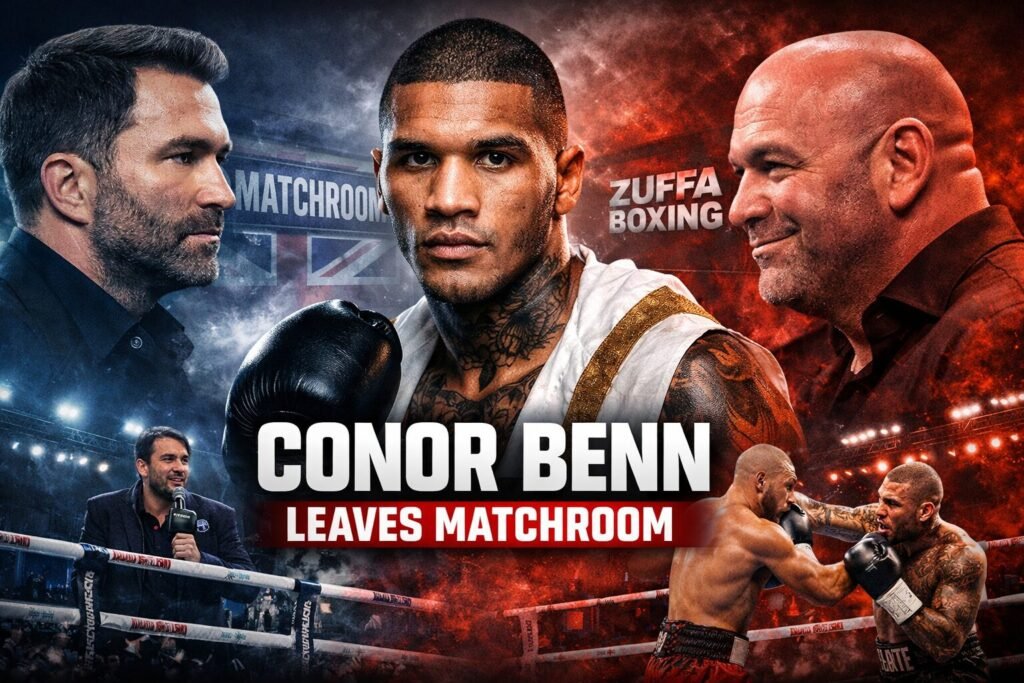
After years under the Matchroom banner, including the most turbulent period of his career, Benn has signed a one-fight deal with Dana White’s Zuffa Boxing. The split has been described by Matchroom CEO Frank Smith as “personal”, with Smith adding that Benn “only cares about himself”.
That’s not neutral language. That’s pointed.
And when Conor Benn leaves Matchroom, it isn’t just a promotional footnote. It’s a career-defining pivot at 29 years old — right as he enters what should be his prime years at welterweight.
So what is this really? Strategic independence? Or a short-term commercial swing?
The Context: Matchroom Backed Him When It Mattered
Let’s not rewrite history.
When Benn’s career stalled following the failed drug test controversy, Matchroom didn’t distance themselves. They defended him publicly. They funded legal support. They kept him visible. Eddie Hearn stood beside him in interviews and press conferences when it would have been easier to step away.
You don’t have to agree with how it was handled to recognise the backing was significant. Even outlets like BBC Sport and Sky Sports covered how closely Matchroom aligned themselves with Benn during that period.
That loyalty matters in boxing. Promoters rarely double down when risk outweighs reward.
Now, with Conor Benn leaving Matchroom, that chapter closes abruptly.
Why a One-Fight Deal Is Interesting
Benn’s agreement with Zuffa Boxing isn’t a long-term promotional shift. It’s a one-fight deal.
That tells you everything.
A one-fight structure means flexibility. No long-term obligations. No multi-fight roadmap. No guaranteed divisional direction. Just an event.
In modern boxing, that often signals an attraction model. Build a headline fight. Sell the night. Move on.
From a business standpoint, it’s clever. Benn retains leverage. He’s not locked in. He can shop around. He can negotiate from strength if the numbers stack up.
But structurally? It muddies the trajectory.
And when Conor Benn leaves Matchroom, trajectory is the only thing that really matters.
The Eubank Win Reset the Narrative
Let’s be clear — the win over Chris Eubank Jr was huge.
It restored credibility. It silenced critics. It shifted conversation away from controversy and back to performance.
That win should have been the launchpad into clear welterweight contention.
Because at 29, Benn isn’t a prospect anymore. He isn’t “building”. He should be targeting champions. He should be calling for sanctioned routes. He should be positioning himself in the WBC, WBA, IBF or WBO rankings with intention.
Instead, Conor Benn leaves Matchroom and steps into a one-fight commercial structure.
Is that ambition — or distraction?
Independence vs Infrastructure
There’s an argument that this is Benn taking control.
Boxers have historically been tied into long-term promotional contracts that restrict freedom. A flexible model could mean he controls his career narrative, his opponents, and his paydays.
But infrastructure matters.
Matchroom operates within established relationships across sanctioning bodies and broadcasters. They have the experience of manoeuvring fighters into mandatory positions and world title fights.
A single-fight partnership, particularly with a relatively new boxing entity under Dana White, is untested territory.
That doesn’t mean it won’t work.
But it is risk.
And when Conor Benn leaves Matchroom, he’s choosing risk at a moment when stability could have accelerated him toward titles.
The Real Question: Titles or Events?
This isn’t about loyalty.
It’s about legacy.
When we look back at Benn’s career in ten years, the debate won’t be about who promoted him. It will be about whether he became a legitimate world champion at welterweight — not an attraction, not a headline act, but a champion with divisional substance.
If the move towards Zuffa Boxing leads directly into world title contention, it’s visionary.
If it becomes a series of commercially attractive but structurally vague events, then Conor Benn leaving Matchroom may prove to be a short-term play.
At this stage of his career, clarity matters more than noise.
So What Is It?
There’s boldness in this move. No question.
There’s also uncertainty.
The timing is what makes it fascinating. Benn has momentum. He has relevance again. He has regained credibility. This should be the moment he locks onto a belt and doesn’t let go.
Instead, we have flexibility. We have leverage. We have intrigue.
Whether that becomes strategic genius or fragmented ambition depends entirely on what comes next.
Because when Conor Benn leaves Matchroom, he’s not just changing promoters.
He’s defining the direction of his prime.
Over to You
Is this smart independence from Conor Benn — or a move that risks turning a potential champion into a pay-per-view attraction?
Drop your thoughts in the comments.
Share this piece if you think trajectory matters more than noise.
And head over to CMBoxing for more straight-talking boxing analysis — because if we don’t ask the structural questions, the hype machine will answer them for us.